adidas World Cup Balls (1970 → 2026)
A complete guide to every official adidas FIFA World Cup match ball design, from Telstar to Trionda.
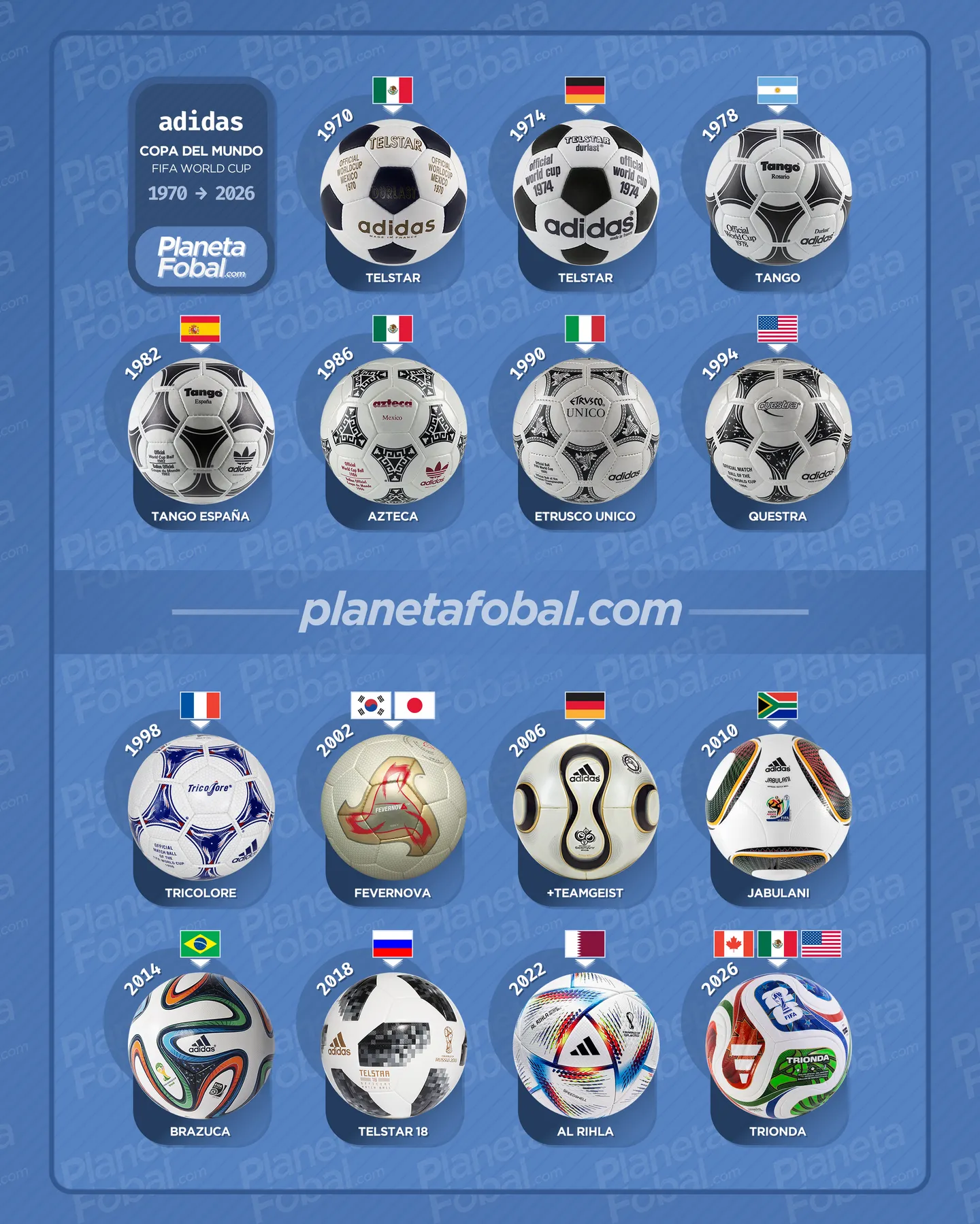
The German sports brand has been the official supplier of the balls used in the matches of the planet’s premier national team tournament for no less than 15 consecutive World Cups.
The history began with the Telstar model developed for Mexico 1970.
In Germany 1974 came the Telstar Durlast, for Argentina 78 one of the most characteristic and recognized adidas balls, the Tango, made its presentation, in 82 it was the Tango España, Azteca in Mexico 86, Etrusco Unico in Italy 90 and Questra in the United States 94.
The first version to leave the classic black and white behind was the Tricolore in France 98 which took the three shades of the French flag, then appeared the already iconic design of the Fevernova in Japan/Korea 2002, the +TeamGeist in Germany 2006 and the Jabulani in South Africa 2010.
For 2014 the brand surprised with the Brazuca which had some particular panels, while for Russia 2018 it was inspired by the first one in history, hence it took its name Telstar 18.
In #Qatar2022 arrived the Al Rihla whose meaning is “The journey” and which stood out for its 20 triangular panels and a design inspired by the culture and architecture of the Asian country.
In the 2026 edition, the first hosted by three countries (Canada, Mexico and the United States), the Trionda will roll, which will stand out for its graphics in blue, red and green bearing characteristic symbols of the hosts such as the Canadian maple leaf, the American stars and the Mexican eagle.
Special versions
In 2006 FIFA decided together with adidas to launch for the first time in history an exclusive version for the final. The design (+Teamgeist Berlin) respected the original but changed the colors to white and gold.
In 2010 (Jo’bulani) and 2014 (Brazuca Final Rio) the same was repeated for the match that crowned the World Champion, while in Russia (Telstar Mechta) the bet was to launch a ball for the knockout stage that started with the round of 16 clashes, in Qatar 2022 (Al Hilm) it was introduced in the semifinals and for the 2026 edition (Trionda Final) a personalized style in gold and black was seen for the first time, highlighting the names of the venues of the final matches.

Before adidas
The first 8 editions had different balls that were made of leather, mostly provided by the host country. Among the particularities, the 1930 final stands out for the use of two different variants, in the first half with one requested by Argentina and in the second with the official one prepared by Uruguay.